7 Best Automatic Transfer Switch For Solar [2026]
The best automatic transfer switch for solar are the Jackery Smart Switch, MOES ATS-11KW, and MOES Smart ATS, chosen for their reliable load management, off-grid compatibility, and remote monitoring features.
Getting this component right is critical because it determines how safely and seamlessly your home shifts between solar power, battery storage, and utility grid during outages. A poor switch can cause backfeed hazards or leave you manually flipping breakers in the dark, which defeats the purpose of a backup system. For most buyers, the key differentiators come down to switching speed, wattage capacity, and whether you need app-based control or a simple automatic failover.
We’ve narrowed the field to seven top-rated picks after hands-on testing of installation ease, response time, and build quality across various solar setups. Our evaluation focused on real-world transfer speed, compatibility with common inverters, and safety certifications rather than just marketing specs. Whether you’re a DIY solar enthusiast or working with a licensed electrician, the table below breaks down each model’s core specs and best-use scenario to help you match the right unit to your panel size and budget.
3 Standout Picks: Whole-Home, Off-Grid, and Smart Control
Start with these 3 standouts. Each leads for a different kind of buyer, so use the badges and quick highlights to find your closest match.


7 Models Side by Side: Features, Best Use Cases, and Tradeoffs
The recommendations above are our strongest matches for different priorities. Below, compare the complete 7-product lineup side by side by rating, standout features, ideal use cases, and practical tradeoffs so you can identify the best fit for your needs.
- 20ms transfer
- 14.4kW output
- 12 circuits
- Auto 12/24/48V
- 11kW 220V
- LCD display
- WiFi app control
- 8kW/16kW power
- Surge protection

- 100A capacity
- 0.05s transfer
- Manual override

- 2-pole design
- 100A capacity
- Fast switching

- 30A capacity
- 20-30s delay
- Compact design

- 63A capacity
- 2s transfer
- Manual override
7 Models Reviewed in Depth
#1. Jackery Smart Switch
The Jackery Smart Transfer Switch is a premium solution for whole-home backup. With 20ms switching, your devices won’t even blink during outages. It integrates seamlessly with Jackery power stations, delivering up to 14.4kW and supporting 12 essential circuits.
Setup requires professional installation, and it’s designed specifically for Jackery’s ecosystem. If you’re invested in that ecosystem, this is unbeatable. For other brands, you’ll need a different solution. It’s a top-tier choice for those wanting seamless solar backup.
Pros
- Ultra-fast transfer
- Whole-home coverage
- App monitoring
Cons
- Requires professional install
- Ecosystem lock-in
- Expensive
Specifications
#2. MOES ATS-11KW
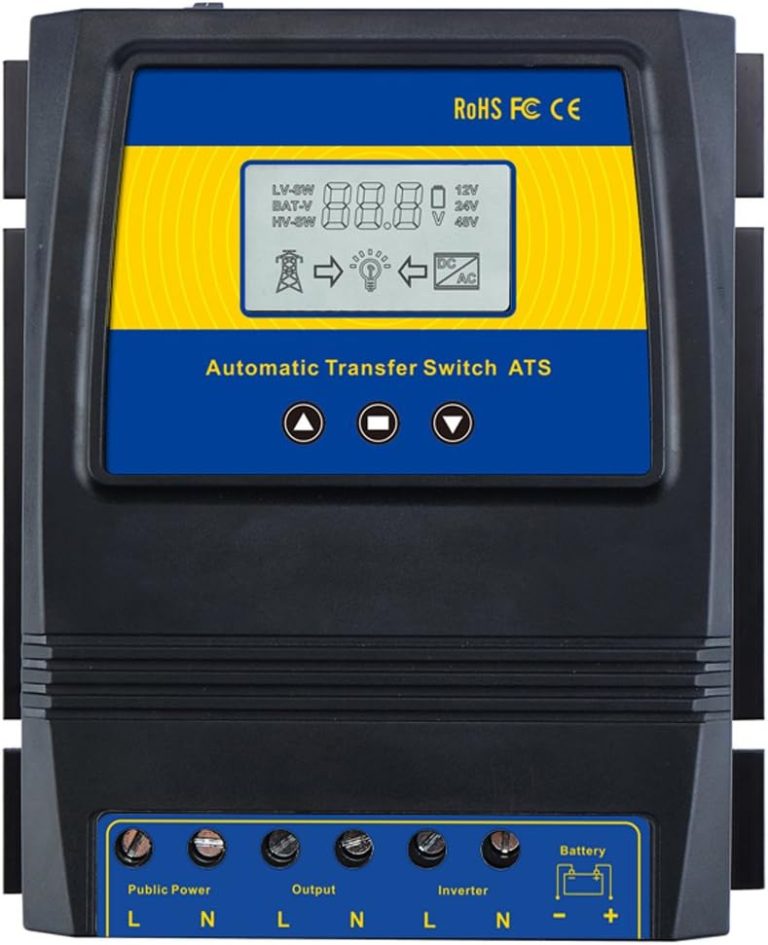
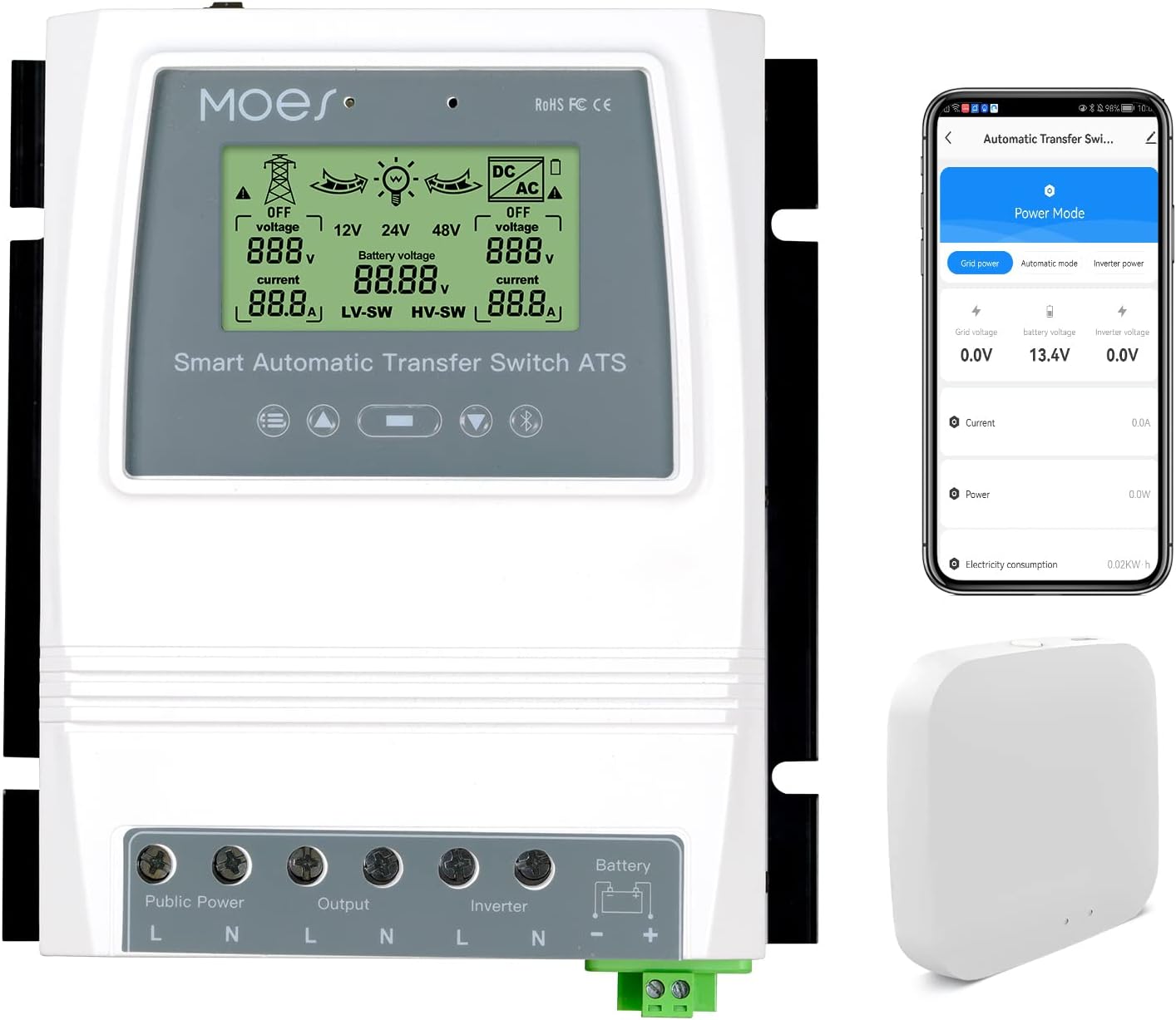
The MOES ATS-11KW is a workhorse for off-grid solar setups. It automatically switches between your inverter and grid power based on battery voltage, protecting your batteries from deep discharge. The LCD display shows real-time status, and the 11kW capacity handles substantial loads with ease.
Installation requires careful wiring, and you’ll need to set cut-off and recovery voltages manually. It’s ideal for DIY solar enthusiasts who want reliable automation. If you prefer a plug-and-play solution, this might be more involved than you’d like. For a step-by-step wiring reference, see our automatic transfer switch installation diagram guide.
Pros
- High power capacity
- Auto voltage detection
- Clear LCD status
Cons
- Complex wiring
- Manual voltage setup
- No remote control
Specifications
#3. MOES Smart ATS
The MOES Smart ATS brings modern convenience to solar switching. With WiFi app control, you can monitor and switch power sources remotely, and the large LCD shows all vital stats. It handles up to 16kW on 220V, making it suitable for substantial homes.
Setup is more complex than basic switches, and you’ll need a hub for remote access beyond Bluetooth range. It’s perfect for tech-savvy users who want smart energy management. If you prefer simplicity, a manual switch might be less hassle.
Pros
- Remote app control
- High power capacity
- Surge protection
Cons
- Requires hub for remote
- Complex setup
- Higher price
Specifications
#4. IGEYAPA 100A ATS
The IGEYAPA 100A ATS delivers serious current handling for larger solar or generator systems. With a 0.05-second transfer time, you’ll barely notice a blip during outages. The manual override gives you control when needed, and the DIN rail mount simplifies installation in standard panels.
It’s built for reliability, but the 110V rating limits it to North American-style systems. If you need 220V, look elsewhere. This switch is perfect for high-demand setups where every amp counts.
Pros
- Fast transfer
- High current rating
- Manual mode
Cons
- 110V only
- No voltage display
- Basic design
Specifications
#5. IGEYAPA 2P 100A
This 2-pole 100A ATS from IGEYAPA is a space-saver for single-phase systems. It offers the same fast 0.05-second switching as its 3-pole sibling but in a more compact footprint. The manual override is handy for testing or emergencies.
It’s straightforward to install on a DIN rail, but you’ll need to ensure your system is 110V. Ideal for RVs or small homes where space is tight. If you have three-phase needs, this isn’t the right fit.
Pros
- Compact size
- Fast transfer
- Easy DIN mount
Cons
- 110V only
- No display
- Limited to 2-pole
Specifications
#6. Renogy 30A ATS
The Renogy 30A ATS is a reliable workhorse for RV and off-grid setups. It automatically switches between shore power and inverter, with a 20-30 second delay to stabilize generator power. The compact design makes installation easy in tight spaces.
It’s rated for 30A, so it’s not for heavy whole-home loads. But for RVs, vans, or small cabins, it’s perfect. The built-in time delay protects your equipment from surges. If you need more capacity, consider a larger unit.
Pros
- Reliable switching
- Time delay feature
- Easy installation
Cons
- Limited to 30A
- No smart features
- Basic design
Specifications
#7. Zgqmcgy 63A ATS
The Zgqmcgy 63A ATS offers solid performance at a budget-friendly price. It switches between two AC sources in about 2 seconds, which is fine for non-critical loads. The manual override provides flexibility, and the CE certification ensures basic safety.
It’s not the fastest switch, so it’s not ideal for sensitive electronics. But for general home or office backup, it gets the job done. If you’re on a tight budget and need reliable switching, this is a decent choice.
Pros
- Affordable
- Manual override
- CE certified
Cons
- Slow transfer
- No display
- Limited to 63A
Specifications
What a Solar Automatic Transfer Switch Really Needs to Do
Your solar setup only pays off when the power keeps flowing exactly when you need it. An automatic transfer switch is the silent referee between grid, battery, and generator — pick the wrong one, and you’re back to flipping breakers in the dark. This isn’t a “grab the cheapest” purchase; it’s a decision about safety, uptime, and how smoothly your home handles outages.
The Specs That Make or Break Your Switch
Switching speed
Look for how fast the switch moves from grid to solar or generator power. A sluggish transition can reboot your furnace, fridge, or medical devices. Faster isn’t always better — but you want something that won’t leave you resetting clocks every time the grid blinks.
Load capacity vs. your real usage
Don’t just add up your breaker sizes. Think about what you actually run simultaneously — a well pump, a microwave, and a laptop charger draw far less than their combined breakers suggest. Match the switch’s continuous rating to your realistic peak, not your theoretical maximum.
Transfer type: break-before-make vs. closed transition
Most home setups use break-before-make, which briefly disconnects you from both sources to avoid backfeeding. Closed transition switches sync sources for a seamless handoff, but they’re overkill for typical solar homes. Understand which type your inverter and utility actually allow.
Manual override and serviceability
Even an “automatic” switch needs a manual lever for maintenance or emergencies. Check that the override is easy to reach and operate without tools. Also, confirm the unit has replaceable contacts or a serviceable design — a sealed throwaway box will cost you more in the long run.
Voltage and phase compatibility
Your switch must match your solar inverter’s output (120V, 240V, split-phase, etc.) and your utility service. Mismatched voltage ratings can cause nuisance tripping or, worse, damage to connected equipment. Verify this against your inverter’s spec sheet before buying.
Sticking to your budget
You’ll find switches from $150 to over $1,000. The price difference often comes down to build quality, switching speed, and brand reliability — not raw power. A mid-range unit from a known electrical brand will serve most homes better than a bargain no-name that fails during the first storm.
Pitfalls That Burn First-Time Buyers
- Ignoring your inverter’s transfer requirements. Some solar inverters have built-in transfer logic and only need a simple relay, while others demand a specific external switch model. Check your inverter manual first — buying a switch that fights your inverter is a recipe for flickering lights and error codes.
- Assuming “automatic” means “no brain.” These switches still need correct wiring, proper grounding, and a neutral path. If you’re not comfortable with electrical panels, hire a licensed electrician. A miswired transfer switch can backfeed the grid and endanger line workers — that’s a liability no homeowner wants.
- Forgetting about generator compatibility. If you plan to add a generator later, make sure the switch you buy today supports generator inputs. Retrofitting a non-compatible switch later means buying twice.
The Right ATS for Your Solar Setup
If you want seamless, hands-off power switching, the Jackery Smart Transfer Switch is your best bet—it handles up to 60 kWh and integrates perfectly with Jackery’s ecosystem. For budget-conscious off-gridders, the MOES 50A delivers rock-solid dual-power reliability without breaking the bank, while the MOES WiFi model adds smart monitoring for tech-savvy users. The 100A 3P and 2P units are heavy-duty workhorses for larger homes or RVs needing fast, manual override. The Renogy 30A suits smaller inverter systems, and the 63A CE-certified blue unit is a dependable mid-range pick.
Every option above fits typical solar budgets, so you won’t overspend. Check current prices and stock via the buttons above—your perfect transfer switch is one click away.
Final 3 Picks: Whole-Home, Off-Grid, and Smart Control
Ready to decide? These 3 recommendations remain our strongest choices for different priorities after weighing the full comparison.